Electrical Fault Finding and Repairs in Norwich and Norfolk
Fast, methodical diagnosis and repair of electrical faults across Norwich, Wymondham,
Attleborough
and the wider South Norfolk area. Tripping fuse boards, flickering lights, dead sockets, warm
plugs, burning smells: we find the cause, explain what is going on in plain English, and put it
right to current standards.
A small number of electrical symptoms
are genuinely dangerous and should never be investigated by anyone who is not a
qualified
electrician. If you have any of the following, stop using the circuit or appliance, turn
off
the relevant breaker at the consumer unit if it is safe to do so, and call us on
07769 201050:
A burning or fish-like smell from a socket, switch, plug or consumer unit
Visible scorch marks, melted plastic or discolouration on any accessory
A socket, plug or switch that is warm, hot or buzzing
Sparks or arcing from a socket, plug or switch
Smoke from any electrical accessory or the consumer unit
Repeated RCD tripping within seconds of the board being reset
An electric shock from any appliance, switch or socket
If the room smells of burning and you cannot
identify the source, turn the main switch off at the consumer unit, leave the
property, and
call us from outside on 07769 201050.
None
of the
above should ever be left until the weekend.
How we work
How we find an electrical fault
Electrical fault finding is a methodical diagnostic process, not guesswork. Every call-out follows
the
same sequence, whether it is a tripping consumer unit in Norwich, a flickering lighting circuit in
Wymondham or a dead socket in Attleborough. At the end of the visit you receive a plain-English
summary
of what the fault was, what we did about it, and whether any follow-up work is recommended.
Where a repair is completed on the day, a Minor Electrical Installation Works Certificate is issued
before we leave. Where follow-on work is recommended, such as a consumer unit upgrade or partial
rewire, you receive a separate written quote. We never start work you have not agreed, and we never
pretend a twenty-minute fix needs a three-hour visit.
Conversation and history
What the symptom is, when it started, what changed just before, what has already been tried.
Visual inspection
Physical damage, overheating signs, DIY alteration, water ingress, rodent damage.
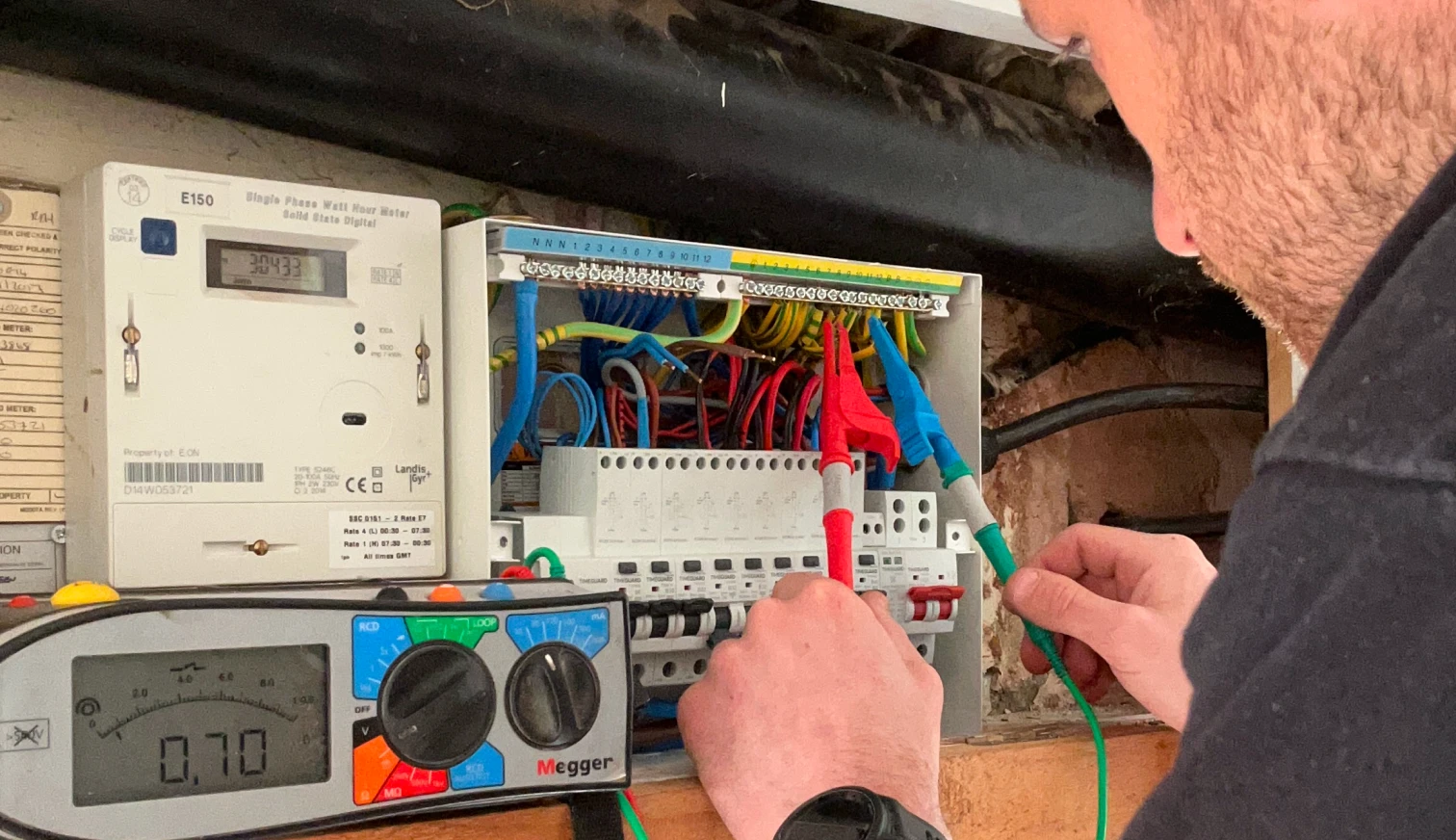
Safe isolation
Locking off the breaker with a proving unit, so nothing is accidentally re-energised mid-test.
Insulation resistance testing
A calibrated 500V test between live conductors and earth. The single most useful diagnostic.
Continuity and polarity
Confirms every conductor is intact and correctly connected.
RCD testing
Measures trip current and trip time to confirm the RCD itself is healthy.
Appliance isolation
Isolate each appliance in turn to separate fixed-wiring faults from appliance faults.
Thermal imaging, where relevant
For commercial jobs and recurring faults, to find hot spots at a glance.
Symptom 1
Why your RCD or fuse board keeps tripping
The single most common call-out we attend. Reset once, reset twice, call on the third trip.
A tripping RCD is a protective device doing its job: it
has
detected current flowing where it should not, and it has cut the power to prevent a shock, a
fire or
worse. The good news is that it caught the fault. The bad news is that there are several
possible
reasons, and finding the right one takes methodical testing.
The most common causes we see in Norfolk homes
A faulty appliance
Ovens, tumble dryers, dishwashers,
washing
machines, kettles, boilers and electric showers are the most frequent culprits. This is
why a
fuse box that keeps tripping with nothing plugged in is a different problem from one
that only
trips when the tumble dryer runs.
Water ingress
An outdoor socket filled with
rainwater, a
light fitting where water has tracked in, a garden office circuit with a compromised
junction.
Classic pattern: RCD trips in the morning, fine by lunchtime.
Damaged cable insulation
Older PVC cable embrittles with age,
particularly where it has been overheated (a cooker cable close to a hob, downlight
cables
touching loft insulation). Insulation resistance testing shows this up cleanly.
A worn RCD
The RCD itself can be at the end of
its
useful life, particularly on boards from the late 1990s and early 2000s. We test trip
current
and trip time to confirm whether the RCD is faulty or correctly responding to a real
fault
elsewhere.
Shared-RCD circuit fault
Common on boards with a single RCD
covering
multiple circuits: a fault on any one circuit takes out the whole side of the board.
Often
resolved permanently with an RCBO-per-circuit consumer unit
upgrade.
Appliance-specific RCD tripping
An oven, boiler, tumble dryer, cooker or washing
machine that trips the RCD every time it is used is almost always the appliance itself, not the
wiring. The quickest way to prove this on-site is to isolate the appliance, reset the board, and
retest: if the board holds, the fault is in the appliance; if it trips again, the fault is
elsewhere. We do this diagnostic on-site during the call-out and can advise whether the
appliance
is worth repairing or replacing, though appliance repair itself is outside our scope.
Symptom 2
What to do if your fuse box keeps tripping
Most people in Norwich and Norfolk still call the consumer unit a “fuse box”. This
section
is about what to do before you pick up the phone.
Resetting the board once is fine. Resetting a second
time
is usually also fine, provided nothing smells of burning and nothing is visibly damaged.
Resetting a
third time without understanding why it tripped in the first two attempts is a bad idea, because
the
fault is either persistent or intermittent, and repeatedly re-energising it carries risk.
If the board has tripped three times in a row,
stop
resetting and call us on 07769 201050. We will
walk you through the basic
diagnostics on the phone: is anything plugged in, does the trip happen instantly or after a
delay,
which breaker is the one that has tripped. In many cases we can book a same-day visit.
If the breaker will not reset at all, that is
also a
signal to stop. A breaker that will not reset usually means the fault is still present on the
circuit, and forcing the lever with a screwdriver or similar is an injury risk. Leave it alone
and
call.
Fuse box keeps tripping with nothing plugged in
One of the most searched questions on the subject,
and
it deserves a direct answer. If the board trips with nothing obviously drawing power, the fault
is
either in the fixed wiring (damaged cable, water ingress, a failed accessory, a loose
connection),
in the consumer unit itself (a failed RCD, a failed RCBO, an internal fault on the busbar), or
in an
appliance permanently hard-wired into the circuit (a boiler, an immersion heater, an outdoor
lighting circuit, an extractor fan). A standard fault-finding visit identifies the cause within
the
first hour in most domestic cases.
Symptom 3
Why lights flicker, and when it matters
Some flickering is harmless. Some is a warning sign of a loose connection that could, over time,
lead
to a fire. Here is how to tell the difference.
Flickering lights are one of the most commonly searched
electrical symptoms in the UK, and the cause varies widely. We find three patterns on Norfolk
call-outs.
Dimmer incompatibility with LED lamps (usually
harmless)
A dimmer sold for incandescent or
halogen
bulbs will often flicker noticeably when used with LED replacements. The symptom is
consistent,
predictable, and is a compatibility issue rather than a fault. Fix: a compatible
LED-rated
dimmer, or a different LED lamp specification.
A loose connection (a genuine safety issue)
Typically at a switch, light fitting,
junction box or the consumer unit. Classic pattern: flickering affecting only some
lights, or a
single light that flickers intermittently and more so when another appliance on the same
circuit
is switched on. The heat at a loose joint can damage insulation over time, so if
multiple lights
are flickering, or a single light is flickering increasingly often, it should be
investigated
promptly.
An issue with the incoming supply
If every light in the house flickers
simultaneously, particularly in a pattern that corresponds to a neighbour's heat pump, a
nearby
industrial site or a car charger on the street, the fault may be with the incoming
supply from UK
Power Networks rather than the house wiring. We can rule this in or out during the visit
and give
you the right contact at UK Power Networks to raise it with.
LED-specific flickering in recessed downlights and
strip lighting is frequently driver-related rather than a wiring issue. We check the lamp type,
driver type and dimmer compatibility before looking deeper.
Pricing
How much does electrical fault finding cost?
Fault-finding is priced differently from other electrical work because the scope is unknown at the
start. The call-out rates below apply in an emergency, or where we cannot establish enough of a
timeframe to agree a written quotation before work begins. The call-out charge covers the first 30
minutes on site and depends on how far we travel; after that, time is charged in 30-minute
increments. Nothing is added to the bill that you have not been warned about first.
Call-out
What is included
Price
Up to 15 miles
First 30 minutes on site: travel, diagnosis, simple repair,
Minor Works certificate where applicable
£65
Up to 25 miles
First 30 minutes on site, as above
£80
Up to 35 miles
First 30 minutes on site, as above
£120
Additional time
Charged after the first 30 minutes, billed in 30-minute
increments, whichever distance band applies
£20 per 30 min
Over 35 miles
We still travel further afield, but the call-out charge is
agreed with you first
Please call to discuss
Follow-up repair work
New accessories, cable runs, consumer unit work that needs
a separate visit
Quoted after diagnosis
How we price, honestly.
We will not quote an all-in “fault finding
price” on the phone because the scope is genuinely unknown until we arrive. What we will
do is
tell you the call-out fee, what it includes, and an honest estimate of likely scope based on
your
description. Most domestic faults are resolved inside the first visit. Where they are not, the
reason is usually that the fault has turned into a bigger job (an old consumer unit that should
be
replaced, a circuit that should be rewired) and the next step is a written quote for that work.
There is no incentive on our side to stretch a diagnostic visit into something longer.
Got a fault now?
Call Scott on 07769 201050 for a written
call-out quote before we leave.
Same-day and emergency electrical response in
Norwich
Most enquiries from Norwich, Wymondham, Attleborough and the surrounding villages can be
attended on
the same working day. If we cannot get to you today, we will tell you on the first call.
Standard response
Same-day, where possible
Most fault-finding enquiries from
Norwich,
Wymondham, Attleborough and the surrounding villages can be attended on the same working
day,
depending on where the team is already committed that morning. If same-day is not
possible we
will tell you on the first phone call rather than leave you waiting, and we will book
the next
available slot.
Best way to reach us:
phone
on 07769 201050. The line goes direct to Scott.
Emergency response
Emergency electrician in Norwich and South
Norfolk
For genuinely urgent cases (no power to
the
property, a landlord responding to a tenant without heat, a commercial premises with
refrigeration or trading at risk, or any of the safety symptoms above) we prioritise the
call-out. Scott covers out-of-hours calls personally: there is no answer service or call
handler
between you and the person who will turn up to the job.
After hours: leave a
clear
voicemail or send a WhatsApp to 07769 201050. Urgent messages are returned personally.
Our process
How a fault-finding call-out with us works
Six steps from phone call to resolution, with a clear path if the fault turns out to be a bigger job.
01
Phone call and triage
Call 07769 201050 and tell us what is happening: what the symptom is, when it started, what
has been tried. We give you an honest indication of urgency, a likely attendance window, and the
call-out fee.
02
On-site arrival
We arrive at the agreed time, introduce ourselves, and start with the conversation and visual inspection described above. Any short power-off windows are agreed in advance so nothing critical is disrupted.
03
Safe isolation and testing
Where testing requires the supply off, we isolate safely using a proving unit, lock off the breaker, and carry out the relevant tests. This is where the fault is identified in almost every case.
04
Repair on the day where possible
Most domestic faults are repaired on the same visit: replacing a faulty accessory, tightening a loose connection, replacing a damaged cable section, replacing a failed MCB, RCBO or RCD. Any parts supplied are itemised on the invoice.
05
Certification and plain-English summary
Where we carry out a repair, a Minor Electrical Installation Works Certificate is issued on the day. Where the fault was diagnosed but needs a separate visit to fully repair, you receive a written summary of findings and a separate written quote.
06
Follow-up where recommended
If the diagnosis uncovers a bigger issue, such as a consumer unit at the end of its useful life, or circuits that should be rewired, we explain the options, provide a written quote, and let you decide in your own time. No pressure to commit on the day.
Peter Buzzle
5 Years ago
Lorem ipsum dolor sit amet, consectetur adipiscing elit. Nunc urna velit, Lorem ipsum dolor sit
amet, consectetur adipiscing elit. Nunc urna velit ...
Read more
FAQs
Fault Finding FAQs
The questions we are asked most often on the phone when someone calls about a tripping board, a flickering light or a dead socket.
Why does my RCD keep tripping?ShowHide
An RCD trips when it detects current leaking to earth. The cause is usually one of a handful of things: a faulty appliance, water ingress, damaged cable insulation, a loose connection, or an RCD that has worn out. On a board where one RCD covers several circuits, a fault on any one of them trips the whole side. Finding which it is takes methodical testing, insulation resistance, appliance isolation and RCD trip-time tests, which is exactly what a fault-finding visit does.
Why does my fuse box keep tripping with nothing plugged in?ShowHide
If the board trips with nothing obviously drawing power, the fault is in the fixed wiring (damaged cable, water ingress, a failed accessory or a loose connection), in the consumer unit itself (a failed RCD or RCBO), or in an appliance that is permanently hard-wired in, such as a boiler, immersion heater, extractor or outdoor lighting circuit. A standard fault-finding visit identifies the cause within the first hour in most domestic cases.
How much does it cost to find an electrical fault?ShowHide
In an emergency, or where we cannot establish enough of a timeframe to agree a written quotation first, we charge a call-out fee covering the first 30 minutes on site — travel, diagnosis and a simple repair where possible. The fee depends on distance: £65 up to 15 miles, £80 up to 25 miles and £120 up to 35 miles, with £20 per additional 30 minutes after that. Further afield, please call and we will agree it with you first. We tell you the fee and what it includes before we start, and most domestic faults are resolved inside the first visit. Where a fault turns into a larger job, the next step is a separate written quote rather than an open-ended bill.
Can you come out today?ShowHide
Often, yes. Most fault-finding enquiries from Norwich, Wymondham, Attleborough and the surrounding villages can be attended on the same working day, depending on where the team is already committed that morning. If we cannot get to you today we will tell you on the first phone call rather than leave you waiting, and book the next available slot. For genuinely urgent cases we prioritise the call-out.
Are flickering lights dangerous?ShowHide
Sometimes. Flickering caused by LED-dimmer incompatibility is harmless and easily fixed. Flickering caused by a loose connection is a genuine safety issue, because the heat at a loose joint can damage insulation over time. As a rule, if multiple lights flicker, or a single light flickers increasingly often, it should be investigated promptly. If every light in the house flickers at once the cause may be the incoming supply rather than your wiring, which we can confirm during the visit.
There is a burning smell from a socket. What should I do?ShowHide
Treat it as urgent. Stop using the circuit, turn off the relevant breaker at the consumer unit if it is safe to do so, and call us on 07769 201050. If the room smells of burning and you cannot identify the source, turn off the main switch, leave the property, and call us from outside. A burning or fish-like smell, scorch marks or melted plastic should never be left until the weekend.
The oven or boiler keeps tripping the RCD. Is it the wiring or the appliance?ShowHide
Almost always the appliance. A specific appliance that trips the board every time it runs points to a fault inside that appliance rather than the fixed wiring. We prove it on-site by isolating the appliance, resetting the board and retesting: if the board holds, the fault is in the appliance; if it trips again, it is elsewhere. We can advise whether the appliance is worth repairing or replacing, though appliance repair itself is outside our scope.
Do you issue a certificate after fault-finding and repairs?ShowHide
Yes. A Minor Electrical Installation Works Certificate is issued on the day for repairs we complete. Where a fault is diagnosed but needs a separate visit to fully repair, you receive a written summary of findings and a separate written quote instead.
Do you cover commercial premises?ShowHide
Yes. We carry out fault finding and repairs for shops, offices, salons, cafes, workshops and other commercial premises across Norwich and South Norfolk, and can schedule around trading hours where needed. Commercial call-outs are quoted individually, and for recurring faults we can bring thermal imaging to locate hot spots quickly.
What if the fault turns out to be a bigger job than a call-out can cover?ShowHide
Honesty first: sometimes a fault-finding visit uncovers a larger issue, such as a consumer unit at the end of its useful life or a circuit that has failed insulation resistance and should be rewired. In that case we complete the diagnosis, make the installation safe on the day where possible, and provide a separate written quote for the follow-on work. You are never obliged to have the follow-on work done by us, but most customers do because the diagnostic knowledge sits with the same electrician. A consumer unit that needs replacing leads to our consumer unit upgrades service; a circuit that needs rewiring leads to our house rewires service.
Service area
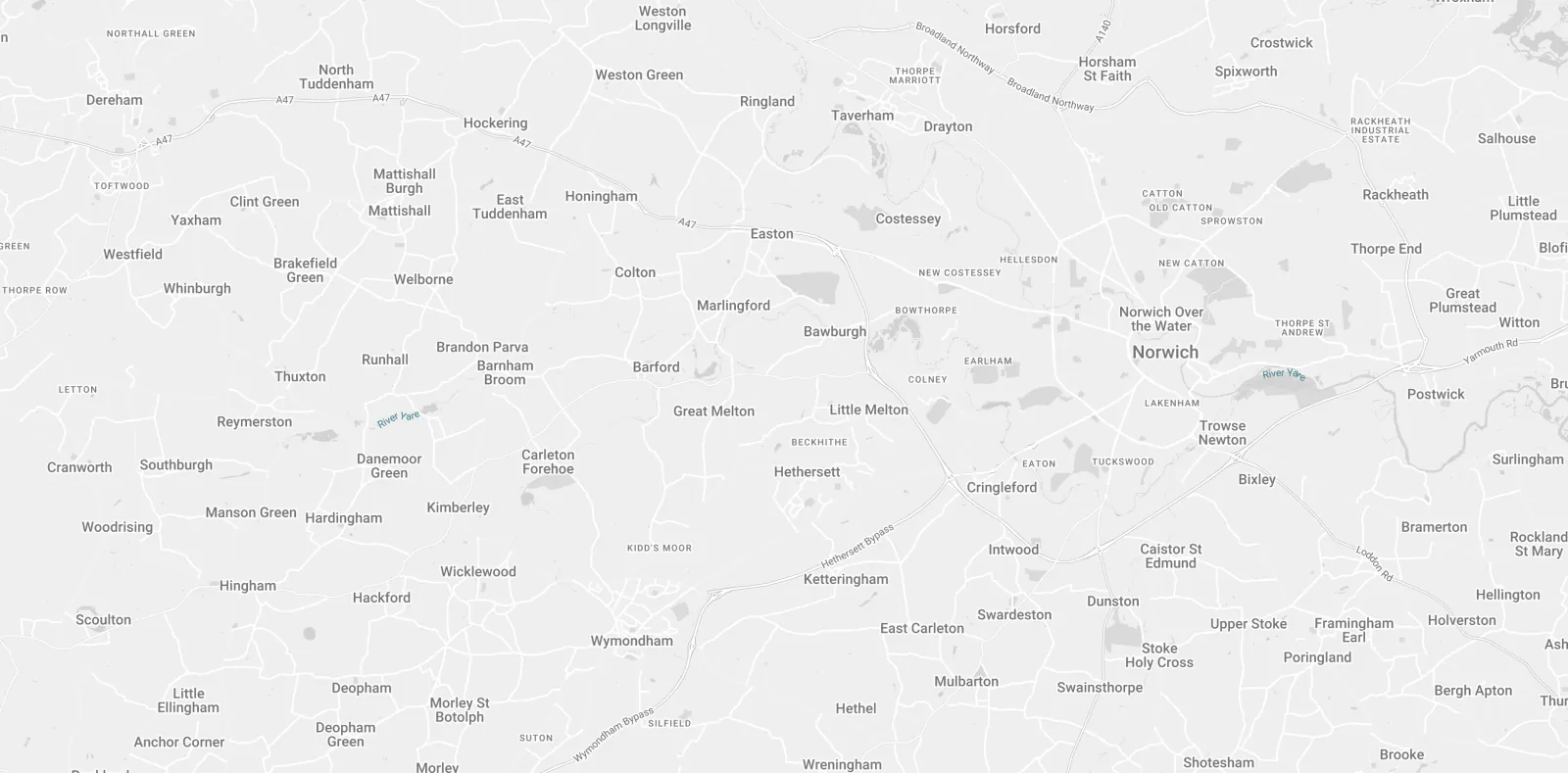
Fault finding across Norwich and South Norfolk
We carry out electrical fault finding and repairs throughout Norwich, Wymondham,
Attleborough, Hethersett, Thetford, Dereham and the surrounding villages including Cringleford,
Costessey, Long Stratton, Mulbarton, Diss and Watton. If you are unsure whether we cover your
postcode, call 07769 201050 and we will confirm straight away.
For fast, honest electrical fault finding and repairs anywhere in Norwich, Wymondham, Attleborough and the wider South Norfolk area, call Hethersett Electrical. Same-day response where possible. Standard call-out fee agreed upfront before we leave.